


How non-alcoholic beer is really made
Three routes, and beer has two that wine cannot use. How brewers answered the hardest part, what Athletic and the German brewers each do differently, and why this category moved so fast.
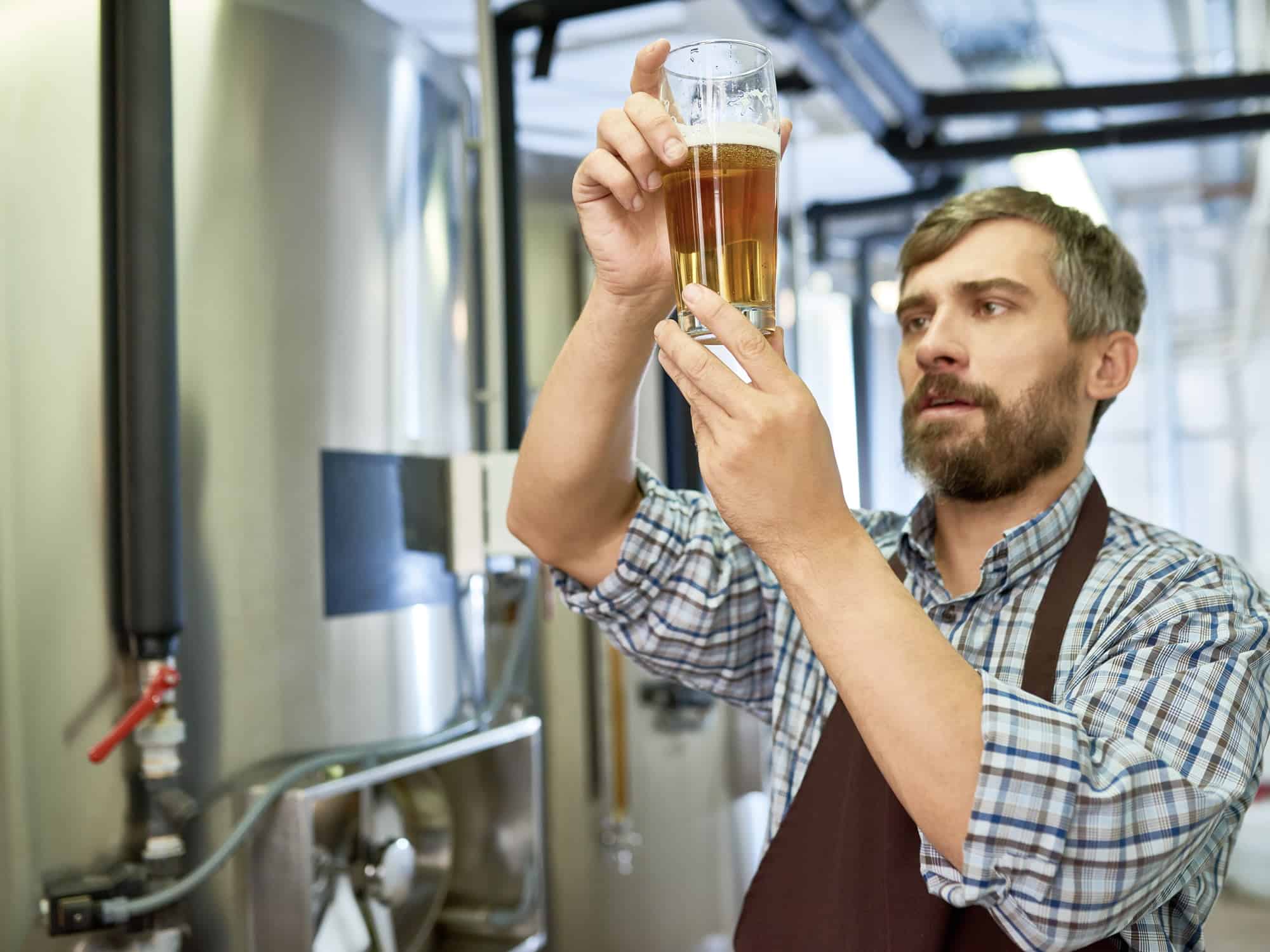
Non-alcoholic beer begins where any beer begins. Malted barley is mashed to convert starch into sugar, the wort is boiled, hops go in for bitterness and aroma. Nothing about that is unusual, and nothing about it is easier.
The thing beer has that wine does not
A winemaker takes the sugar the grapes arrived with. A brewer makes the sugar — mashing temperature, grain bill and time all decide how much of the starch becomes fermentable. That opens two routes unavailable in a winery: build a wort that yields little alcohol, or use a yeast that cannot ferment most of what is in it.
It is why non-alcoholic beer moved so fast, and why small breweries could join in. One of the three routes below costs a yeast order rather than a capital programme, and that changed who could make this. Wine has no equivalent.
Three routes, three different crafts
| Route | Type | What it asks of the brewer |
|---|---|---|
| Remove the alcohol | Physical | Brew fully, then take the ethanol out by vacuum distillation or reverse osmosis. Keeps the character a full fermentation produces. Needs dedicated equipment, which is why large brewers went first. |
| Stop the fermentation | Biological | A low-sugar wort, fermented briefly. No new kit. The craft is in building a wort that tastes finished when it has barely started — hop timing, mashing regime and adjuncts doing work fermentation would otherwise do. |
| Use a yeast that cannot | Biological | Some yeasts physically cannot ferment maltose, wort’s main sugar. Saccharomycodes ludwigii is the reference strain. Chosen as much for the esters and acids they do produce as for the alcohol they do not. |
What brewers built to solve the hardest part
The problem everyone recognised early was wortiness — a barely fermented beer tastes of sweet cereal, because that is largely what it is. The first answers were cosmetic: adding aroma compounds such as isoamyl acetate, which reads as banana, over the top of it.
The real answer came from yeast selection, and it is a genuinely impressive piece of work. Non-conventional strains produce fruity and spicy esters, organic acids and glycerol — body, acidity and aroma generated biologically rather than added. Breweries pair that with hotter mashing to leave less fermentable sugar, and adjuncts such as rice that cut the cereal note at source. Screening programmes have worked through dozens of strains looking for the ones that do this best.
Cold-contact fermentation with Torulaspora delbrueckii at 10L scale. Full citations in Sources below.
That is the achievement worth sitting with: a beer fermented to under a tenth of a per cent, nothing taken out and nothing added to disguise it, that tasters could not meaningfully separate from an ordinary lager. That result did not exist ten years ago, and it exists because people went looking for it.
Who does what
Breweries are generally guarded about the specifics, which is reasonable in a competitive market and is itself a fair indication of how much work went into them. What is public is still enough to show how differently people have approached the same problem.
Athletic Brewing. Bill Shufelt stopped drinking in 2013, could not find anything he wanted, and recruited John Walker, a head brewer out of Santa Fe. They spent four months and more than a hundred test batches on homebrew equipment in an empty building before they had a process worth scaling. Athletic says its beer is fully fermented to under 0.5% with no alcohol removed afterwards and nothing added, achieved through around ten changes to the traditional process including close control of temperature. They then built a brewery around the method rather than adapting one, and every can is tunnel-pasteurised — the stability problem taken seriously rather than hoped away.
The German brewers. Alkoholfrei has been a mainstream category in Germany for decades rather than a recent arrival, and it shows. Erdinger — the world’s largest wheat beer brewery, founded in 1886 — launched its Weissbier Alkoholfrei in 2001, when the alternatives elsewhere were thin lagers nobody defended. Weihenstephaner has been brewing since 1040 and treats its alcohol-free the way it treats everything else. That head start is why German non-alcoholic beer was good before most people had noticed the category existed.
Estrella Galicia. A large regional brewer from A Coruña whose 0,0 is built as a session lager in its own right rather than as a reduced version of the flagship. Worth knowing if you want a beer that tastes Spanish rather than one that tastes like a compromise.
The through-line is that nobody here is trying to make a copy. Athletic brews styles the old methods could not support precisely because its process is not built around removing alcohol from a finished beer. The German brewers make alcohol-free versions of what they already do well. Both are making beer, not making do.
Carbonation is a control, not a compromise
In an ordinary beer the bubbles are a by-product of fermentation. With little or no fermentation there is little or no carbon dioxide, so most non-alcoholic beer is carbonated on the line — as a great deal of ordinary beer is. Carbonation level is tuned deliberately, and because carbonation lifts aroma toward the nose it is one of the levers brewers use to get more out of the beer they have made.
Keeping it stable
Alcohol is a preservative, so a beer without it needs another one. Pasteurisation, sterile filtration and tight packaging do that job instead, and doing it well is why a good non-alcoholic beer tastes the same in month six as it did in month one. It is the same problem dealcoholized wine has, solved with brewery equipment.
You cannot read this off a label
Which route a brewery took is almost never on the can. There is no field for it and no requirement to declare it, so the only reliable source is the brewery’s own account — and unlike wine, a good many breweries are proud of the answer and publish it. Where they do, we record it on the listing in their terms. Where they do not, we leave it blank rather than infer it.
Sources
- Frontiers in Microbiology. Application of unconventional microorganisms for the production of non-alcoholic beer Frontiers, 2026
- Beverages. Influence of wort composition and fermentation parameters on metabolic activity of non-Saccharomyces yeast in non-alcoholic and low-alcohol brewing MDPI, 2026
- Aroma potential of a new maltose-negative yeast isolate. On limited fermentation, dealcoholization and maltose-negative yeasts PMC, 2025
- Good Beer Hunting. Out of the penalty box: Athletic Brewing Company goodbeerhunting.com, 2020
- Athletic Brewing. Our beer and the Athletic difference athleticbrewing.com, 2026
Common questions
Why did non-alcoholic beer get good faster than non-alcoholic wine?
Because a brewer designs the sugar. A wort can be built so that little alcohol ever forms, which is not possible with grapes — so beer has biological routes that need no special equipment.
Why does some non-alcoholic beer taste malty or sweet?
That is wortiness, from a fermentation stopped early. Modern yeast strains largely solve it by producing esters and acids that displace the cereal note rather than masking it.
Is it force-carbonated?
Usually, because with little fermentation there is little carbon dioxide. So is plenty of ordinary beer. It also lets a brewer tune carbonation deliberately, which lifts aroma.
Does non-alcoholic beer go off faster?
It would, without help. Alcohol is a preservative, so brewers use pasteurisation, sterile filtration and careful packaging instead. A well-made one is shelf-stable.


