


Sober Bars, Bottle Shops and Pop-Ups
There is probably not a dry bar near you. That turns out not to be the question — there is a whole ladder of places to go without alcohol, and most of it is closer than the bar.
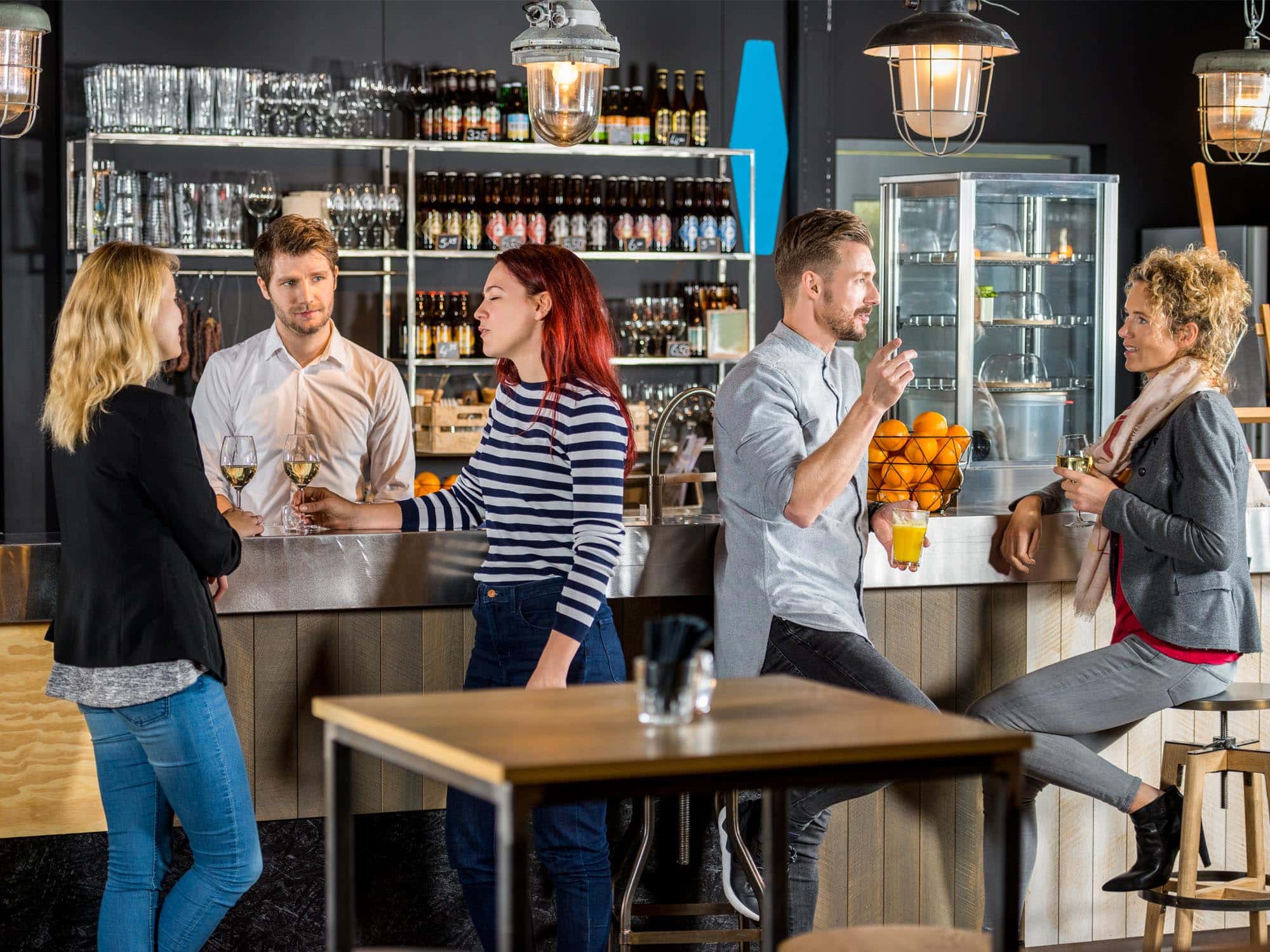
Most people arriving at this question have already searched for a sober bar near them and found nothing. That is the usual result. Dedicated alcohol-free bars are real — Sans Bar opened in Austin in 2017 and is generally reckoned the first in North America — but there are a few hundred of them in a country of forty thousand towns.
The mistake is concluding there is nowhere to go. There are four other kinds of place, most of them more numerous than the bar, and one of them is almost certainly within a few miles of you.
Two different things share the name
Worth knowing before you turn up. A sober bar is often a recovery space first: it runs support groups, its founder is usually in recovery, and the room is built around community rather than around a night out. The one in Crystal Lake, Illinois has hosted meetings since 2013.
An alcohol-free cocktail bar is a nightlife venue that happens not to serve alcohol. Same absence, different room.
Both are good. They are not interchangeable, and the search results do not distinguish them. If you want one and get the other it will feel wrong for reasons you cannot immediately name.
The ladder, most available first
1 · An ordinary bar with a real menu
The most likely place to get a good drink without alcohol is a normal bar. The trade now treats a zero-proof list as standard rather than as a courtesy, and the better ones build it with the same effort as the cocktail menu.
The trick is asking well. “What do you have that is non-alcoholic” gets you a list of sodas. “What can you make me that is not sweet” gets you a bartender thinking, and it is the single most useful sentence in this article. If they have anything good, that question finds it.
It works because most bars can make far more than the menu says. The soda gun is not the limit — there is citrus, there is bitters, there is usually a syrup or two, and somebody behind the counter who would rather build something than pour a Coke. What comes back is often better than the two printed options.
2 · A bottle shop with a counter
These have multiplied faster than bars, and they are the underrated answer. A dedicated alcohol-free bottle shop stocks somewhere between seventy and a hundred brands, and many of them pour — you can drink one there, or take it home, or both. Several run weekly tastings, which is a social evening that costs the price of a bottle.
They also solve the problem the bar cannot: you leave knowing what you like, with the thing you liked.
Where there is no dedicated shop, a good liquor store or a large grocer will usually carry alcohol-free beer, because beer is the most established part of the category and the easiest thing to stock. Zero-proof spirits are much harder to find on a shelf and are mostly bought online — which is worth knowing before you drive somewhere hoping.
3 · A pop-up
The one people miss, because it does not show up on a map. Alcohol-free pop-ups take over an existing venue for a night and move on, so a city with no dry bar may well have a rotating one. This is also how most of the permanent places started — Sans Bar ran pop-ups around Austin before it had a room, and the shop in Chicago’s West Town did the same.
Because they have no address, they are found through social media and local mailing lists rather than through search.
4 · A sober event
Alcohol-free raves, morning dance parties, roller nights, ecstatic dance. There are also festivals — one in Washington DC runs a tasting hall with over a hundred non-alcoholic drinks from forty producers.
These are the version for people who wanted the night out rather than the drink, and they tend to be better attended than the bars.
5 · A dedicated alcohol-free bar
Best when it exists, and worth travelling for. The room is the product: nobody is drinking, so nobody is managing anybody else’s drinking, and the evening does not change character at eleven.
What it costs
A zero-proof cocktail generally lands between ten and fifteen dollars — at, or slightly under, the price of the alcoholic version on the same menu. That surprises people who expect it to be priced like a soft drink.
It is defensible. The labour is identical, the non-alcoholic spirit costs what it costs, and a bar pricing it like lemonade is usually a bar that made it like lemonade.
“Zero-proof” on a menu does not always mean 0.0%
This is the thing we can tell you that a listings site cannot.
Several ingredients that turn up in zero-proof cocktails are not alcohol free. Cocktail bitters are usually a spirit — Angostura Aromatic states 44.7% ABV on its own label, higher than most whiskey. Kombucha carries trace alcohol from fermentation. Neither is likely to be flagged on a menu, because in a finished drink the quantity is small.
Whether that matters is entirely yours to decide, and it is not something we or a bartender should decide for you. But it is worth knowing that asking is a reasonable question rather than a fussy one, and any decent bar will answer it without a fuss.
Finding one near you
Search results conflate all five kinds and miss the pop-ups entirely. Directories of verified alcohol-free venues exist and are better than a map search — one currently lists several hundred across more than forty cities.
Beyond that: ask at the bottle shop if there is one, because they know what is happening locally; follow the pop-ups rather than the venues; and check whether the good cocktail bar in your town has a zero-proof list, because it probably does and nobody has told you.
When there is nothing near you
Which, for most of the country, is the honest answer.
At that point the thing missing is not the drink. It is the occasion — a reason to be somewhere, at a time, with people, holding something. And unlike a bar, that is something you can make.
The other half of a bar is the drink, and that part is genuinely reproducible. The ones people actually order out — a negroni, a mojito, an espresso martini — are three or four ingredients and nothing you do not already own. At ten to fifteen dollars a glass out, the first bottle pays for itself in a week.
One thing worth knowing before you start: a good non-alcoholic drink is not the alcoholic one with the spirit left out. Take the gin out of a negroni and it collapses — the bitterness has nothing to push against. The versions that work are rebalanced rather than subtracted, which is why the recipes section writes them from scratch.
The ones people order out
Three or four ingredients each, and nothing you do not already own.


The bottle-shop model works at home and is how most people find out what they like: buy three or four different things, open them across an evening, decide. It is a tasting rather than a purchase, and it is more interesting than committing to one bottle you chose from a photograph.
And if you want the full version: every scene in this article started with somebody deciding to run a night. Sans Bar was pop-ups before it was a room. A table, six people, four bottles and a reason is the smallest possible version of the same thing, and it works the same way a party does.
If what you are looking for is closer to the recovery end — a room with people who understand why you are there rather than a night out — the guide to alcohol-free living has the resources for that, and they are better than us at it.
Sources
Regulatory and composition facts. No claim is made about what any drink does.
- Gallup. U.S. Drinking Rate at New Low as Alcohol Concerns Surge, Consumption Habits survey, 2025
- Bevvy. Bitters’ ABV and Their Use in Nonalcoholic Cocktails
Common questions
What is a dry bar?
A bar that serves no alcohol. In practice the name covers two different rooms — recovery-focused community spaces, and alcohol-free cocktail bars built for a night out. Both are worth going to; they are not the same experience.
How do I find a sober bar near me?
Start with a verified directory rather than a map search, because map results mix in ordinary bars. Then check the bottle shops, which are more numerous and often pour, and follow local pop-ups, which have no fixed address and never show up in search.
What do sober bars serve?
Zero-proof cocktails built like cocktails, alcohol-free beer and wine, and increasingly house-made things — shrubs, infusions, kombucha on tap. Not soft drinks with a garnish.
How much does a non-alcoholic cocktail cost at a bar?
Usually ten to fifteen dollars, at or just below the alcoholic version on the same menu. The labour is the same and the ingredients are not cheap.


